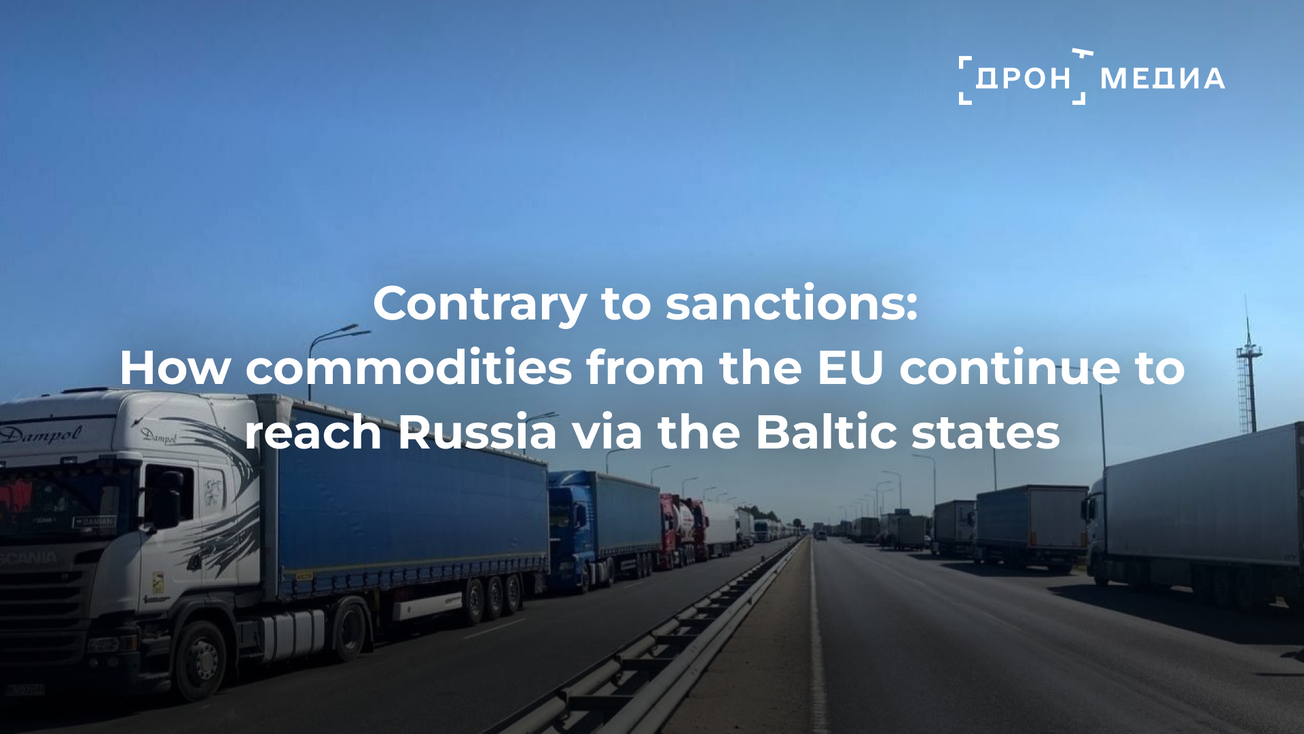
Since Russia’s full‑scale invasion of Ukraine, Lithuania, Latvia and Estonia have championed for the strictest EU sanctions against Moscow. They have also actively advocated for restrictions - though less severe than those targeting Russia - against the Kremlin’s main regional ally, Belarus.
These limitations, in particular, include a complete ban on issuing tourist visas to Russian and Belarusian citizens, a move that many other EU member states declined to support. The Baltic governments have also tightened the issuance of residence permits, limited transportation links with Russia and Belarus, and imposed restrictions on property purchases.
Although the Baltic governments adopted a tough line in their rhetoric, local businesses remained more cautious and did not back an immediate cut-off of commercial and trade ties with Russia and Belarus.
As many supplies became illegal to deliver directly to Russia, export routes were redirected to post‑Soviet nations in Central Asia and the Caucasus. Economists and experts are positive that a significant portion of these goods was subsequently re‑exported en masse to Russia.
Dron.media conducts a detailed analysis of the external trade data from the Baltic states, speaks with officials and experts in these countries to understand how export flows has evolved over four years of war.
Thousands of violations
According to Estonia’s Tax and Customs Board, nearly 3,900 violations of sanctions connected to exports of commodities were detected in 2025. Admittedly, most of these were committed by private individuals and were minor - typically attempts to smuggling of large amounts of undeclared cash in euros.
Some violations reported by the customs officials in recent months were even almost comical.
For instance, someone attempted to smuggle two expensive horse saddles into Russia. Another case involved an attempt to carry a pair of ice skates, which are considered "luxury goods". In fact, these have been two cases of skates smuggling in recent months – most recently, in March, when offender was fined, and the skates were confiscated.
Cases where companies are caught violating sanctions involving sanctions when exporting commodities are less frequent. However, when they happen, the amounts in question reach millions of euros.
In March, Estonian law‑enforcement authorities announced that the country’s national has been operating for several years through "various companies", exporting luxury vehicles from the EU to Russia and Belarus. The authorities believe that over 200 cars worth a total of EUR25mn were illegally imported.
"This was a large‑scale and carefully planned scheme aimed at making a profit and evading the sanctions," the nation’s Prosecutor General Eneli Laurits said.
In its 2025 report, Estonia’s Tax and Customs Board says that the majority of violations by companies were concentrated in the following commodity categories:
- Wood and wood products, charcoal;
- Vehicles and their parts, accessories;
- Machinery and mechanical equipment;
- Electrical machinery and equipment;
- Iron and steel products.
The board explicitly warns that in case of rail shipments, special attention should be paid to deliveries to Belarus, Central Asian countries, and the Caucasus.
"Although EU sanctions restrict the import and export of goods to Russia, transit of sanctioned goods through Russia remains permitted. Businesses should be aware of the high risks involved in such transit, as delivery to the final destination is not always guaranteed," the report says.
Abnormal statistics
Since the beginning of full‑scale invasion of Ukraine, Estonia’s trade data – similar to that of Latvia and Lithuania - has shown an abnormal surge in the volumes of exports of certain product groups to Kazakhstan, Kyrgyzstan and Armenia.
Specifically, exports to Kazakhstan surged sevenfold during the first year of the Ukraine war. Exports to Kyrgyzstan, which were minimal prior to the war - amounting to EUR283,000 in 2021 - expanded to EUR15.5mn in 2022.
A similar atypical spike in the dispatch of goods, many of which are banned from direct export to Russia, was also observed in the other Baltic states.
Estonia’s commodities exports (2021-2025, EUR)
|
2021 |
2022 |
2023 |
2024 |
2025 |
Kazakhstan |
11,018,390 |
77,793,284 |
106,455,214 |
41,698,381 |
46,288,313 |
Kyrgyzstan |
282,689 |
15,446,994 |
69,514,418 |
48,835,169 |
31,921,618 |
Armenia |
1,410,115 |
27,329,001 |
20,564,058 |
27,967,329 |
18,315,531 |
Source: Statistics Estonia
"Part of it was due to the need to find new trading partners, as Russia became a high-risk area for transport operators, and partly because some companies operating within the EU attempted to bypass sanctions," Ursula Riimaa, the deputy director general for customs at the Estonian Tax and Customs Board, said in an interview with Dron.media.
She stated that once indications of widespread sanctions evasion appeared, the authorities responded swiftly. "We developed maps for high-risk goods and companies and worked together with neighbouring countries to implement joint control measures to prevent violations. These efforts proved successful, resulting in a notable decrease in trade with ‘high-risk’ countries," Ursula Riimaa noted.
Cars, spare parts, metal products
Paulis Iljenkovs, Deputy Head of Latvia’s Financial Intelligence Unit (FIU), affirms the Estonian authorities’ conclusions regarding sanctions evasion through Central Asia and the Caucasus. Starting in 2024, this agency has been the exclusive government entity tasked with investigating possible violations of sanctions against Russia concerning exports from Latvia.
He explains that unusual export figures suggest businesses are attempting to bypass sanctions. Since exports to these countries are not outright banned, the Baltic states can only enhance control measures and prosecute violators.
"If a vehicle officially recorded as being sent to Kazakhstan should be discovered in Russia, the exporting company’s proceeds from the sale will be seized," Paulis Iljenkovs noted in an interview with Dron.media.
Trade data from 2024 to 2025 indicates a significant decrease in exports from the Baltic states to post-Soviet nations, which may further re-export sanctioned goods to Russia. However, exports across many product categories continue to be unnaturally high compared to pre-war levels.
Export of vehicles from Estonia, excluding railway and tram rolling stock, along with their parts and accessories (2021-2025, EUR)
|
2021 |
2022 |
2023 |
2024 |
2025 |
Kazakhstan |
280,588 |
8,441,837 |
10,295,563 |
5,022,771 |
4,844,553 |
Kyrgyzstan |
33,900 |
2,032,752 |
18,769,285 |
17,906,588 |
6,445,630 |
Armenia |
37,450 |
3,336,019 |
3,315,700 |
5,422,661 |
1,168,402 |
Source: Statistics Estonia
Notably, Estonia’s exports to Central Asian countries have decreased by about 30% compared to 2023. The most significant drops were observed in categories such as automotive spare parts, timber and wood products, and rolled metal products. It was in those product groups that the Estonian customs authority suspected widespread circumvention of sanctions.
Currently, supplies to Armenia account for roughly 1.25% of Estonia’s total exports. A decline has been reported in recent years, primarily due to reduced shipments of vehicles and their parts.
Vehicle exports from Estonia are now subject to inspections conducted after customs clearance. Where subsequent re-exports to Russia is discovered, further deliveries by a violating entity are suspended until the exporter "is capable of demonstrating adequate discretion to prevent such re-exports in the future," says Ursula Riimaa.
Is Brussels losing patience?
According to Paulis Iljenkovs, the main reasons for the decline in export volumes are both the tightening of control measures within the Baltic states and the European Commission’s persistent efforts to urge post-Soviet countries to curb re-exports.
For some time, Brussels officials have been negotiating with Central Asian and Caucasus countries, seeking to convince them to address the flow of re-exports to Russia. The European Commission has consistently maintained that it relies solely on diplomatic pressure and persuasion, while avoiding making threats of severe sanctions against these nations.
However, in recent months, it seems Brussels has been losing patience with Central Asian and Caucasus countries, as the situation with certain categories of goods remains far from resolved—they continue to be widely re-exported to Russia. Some of these goods may also be used in the military industry.
In April, for the first time in history, the EU activated its "anti-circumvention tool" targeting Kyrgyzstan, following the re-export of a number of sanctioned items from the country to Russia, according to a statement from the European Council.
Brussels prohibited the export of computer numerical control machines and telecommunication equipment, including routers and switching devices, to Kyrgyzstan.
"This decision follows a thorough analysis of trade data showing a significant surge in re-export of common high-priority items through Kyrgyzstan to Russia," the statement reads.
According to Brussels, between January and October 2025, deliveries of these goods from the European Union to Kyrgyzstan were nearly 800% higher than pre-war levels, while exports of the same goods from Kyrgyzstan to Russia increased by 1,200%. The specific EU countries supplying these goods to Kyrgyzstan were not indicated in the report.
Meanwhile, Kyrgyz Deputy Prime Minister Daniyar Amangeldiev told Western media that Kyrgyzstan’s contribution to the overall re-export of many sanctioned goods to Russia is "extremely minor."
"Some of these goods were not supplied at all [before the war], and now, if just 100 units are imported, it is immediately regarded as a 100-fold increase," he complained. He also said that "not a single European country" made direct claims against Kyrgyzstan regarding re-exports to Russia.
Tightening controls vs new routes
Ursula Riimaa notes in an interview with Dron.media that the decline in Estonia’s exports to Central Asian and Caucasus countries during 2024–2025 was partially caused by increased control measures.
"In August 2024, Estonia introduced comprehensive customs controls at its eastern border for departures - neither goods, nor travellers, nor vehicles are permitted to cross without inspection. Moreover, vehicle traffic and overnight crossings were halted at the Narva checkpoint; similar restrictions were also applied at the Luhamaa and Koidula border crossings," she explains.
Paulis Iljenkovs points to the early 2024 agreement signed by the Baltic states to harmonize customs controls, enabling a unified approach across the region.
Ursula Riimaa adds that the legislative amendments enacted in April 2025, empowered the Estonian Tax and Customs Board to treat minor sanctions violations as administrative offenses and to initiate criminal proceedings for more serious or repeated violations related to the import and export of goods.
"This significant additional tool has helped slash the number of repeat offenses and render criminal proceedings more efficient and swifter," she said.
Export of vehicles from Lithuania, excluding railway and tram rolling stock, along with their parts and accessories (2021–2025, EUR thousand)
|
2021 |
2022 |
2023 |
2024 |
2025 |
Kazakhstan |
43,737.6 |
125,664.1 |
143,388.9 |
48,394.8 |
31,078.0 |
Kyrgyzstan |
13,104.2 |
84,777.8 |
132,032.6 |
29,349.8 |
22,152.8 |
Armenia |
488.9 |
43,822.5 |
36,309.4 |
1,833.6 |
1,314.0 |
Source: Statistics Lithuania
Export of cocoa and cocoa products from Lithuania (2021–2025, EUR thousand)
|
2021 |
2022 |
2023 |
2024 |
2025 |
Kazakhstan |
443.4 |
931.7 |
1,263.3 |
1,204.9 |
1,014.5 |
Kyrgyzstan |
139.0 |
281.1 |
597.6 |
830.5 |
541.9 |
Armenia |
16.8 |
2,655.1 |
3,844.3 |
18.7 |
3.7 |
Source: Statistics Lithuania
In the meantime, Russian logistics companies, which analyse the market for delivering sanctioned goods into the country, claim that the authorities in Kazakhstan and, to some extent, Kyrgyzstan, have indeed tightened their re-export policies.
"Kazakhstan and Kyrgyzstan, long-standing major transit hubs, are under intense pressure from the U.S. and the EU. Banks in these countries are generally declining to process transactions with Russian partners, while customs authorities are conducting more thorough inspections of ‘dual-use’ cargoes. Consequently, logistics companies have adjusted their routes to use less visible channels, such as Uzbekistan and Tajikistan, where control remains weaker," a spokesperson for the Russian company Sky Cargo Service says.
The company also notes that Vietnam, Malaysia, Indonesia, and Singapore are currently emerging as new transshipment centres for goods headed to Russia.
"Fragmentation and decentralization"
The Latvian State Revenue Service, when commenting on efforts to circumvent sanctions against Russia, describes the process as "complex and constantly evolving due to the international nature of trade and sophisticated evasion tactics."
"There are various challenges, including fraud involving false combined nomenclature codes, misinformation about the destination country, and document forgery," a senior official said in an interview with Dron.media.
He added that the Latvian customs service has focused on effective international cooperation, information exchange, and coordinated control measures within the EU. "Latvia is actively involved in these efforts and has significantly strengthened its legal framework and operational capacity in recent years," he concluded.
Paulis Iljenkovs believes the primary challenge lies in the "fragmentation and decentralization" of efforts to combat sanctions evasion within the EU.
"In my opinion, we’ve established a system that functions effectively. However, in Latvia, there have been 700 investigations into potential sanctions violations, while in some other EU countries, there have been none," he notes.
The official further explains that the bigger issue for the Latvian controlling authorities is the transit of goods manufactured in other EU nations. "Eighty percent of sanctions breaches detected are linked to companies from other EU countries," he tells Dron.media.
Swedbank economists assess that at the beginning of 2022, Russian imports of goods produced in the Baltic states represented just 2% of the region’s overall exports. In contrast, re-exports of goods made in other countries to Russia were considerably higher, especially in Lithuania, with over 10% of the country’s total exports, and Latvia, with approximately 7.5%.
Sanctions imposed on Russia resulted in the loss of a significant portion of Latvian exports to these markets, which slowed economic growth, particularly in 2022. The logistics sector was among the hardest hit across the Baltic economies.
Additionally, the Baltic states became vulnerable due to the reduction in import flows from Russia and Belarus, especially Lithuania, where imports from Russia made up approximately 12.5% of total imports. As of early 2022, the Baltic countries imported substantial amounts of oil, natural gas, timber, metals, and fertilizers. Some companies in Lithuania, Latvia, and Estonia experienced short-term supply disruptions of these and other goods as they sought new suppliers.
The initial uncertainty triggered by the war in Ukraine also led to delays in some private investments in the region.
Belarusian transit
Compared to Russia, a smaller number of product categories are restricted for export from the EU to Belarus. This creates challenges in monitoring sanctions circumvention, especially for Lithuania and Latvia, which share a border with Belarus.
Export of meat and meat products from Lithuania to Belarus (2021–2025, EUR thousand)
2021 |
2022 |
2023 |
2024 |
2025 |
2,192.0 |
8,343.4 |
12,858.4 |
10,461.2 |
7,428.5 |
Source: Statistics Lithuania
Export of cocoa and cocoa products from Lithuania to Belarus (2021–2025, EUR thousand)
2021 |
2022 |
2023 |
2024 |
2025 |
4,472.4 |
4,251.2 |
13,415.1 |
8,420.8 |
11,209.4 |
Source: Statistics Lithuania
Economists are quite concerned that, between 2022 and early 2024, Belarus became a transit hub for vehicles banned from entering Russia following the outbreak of the war in Ukraine.
It was only as late as June 2024 that the Lithuanian authorities started enforcing stricter controls on the export or transit of passenger cars up to five years old through Belarus from the EU.
Currently, the export of passenger cars is only allowed if performed by the owner of the vehicle (if purchased by an individual), not by their close relatives or persons holding a power of attorney.
Furthermore, exporting these cars from Lithuania now requires additional documentation, including confirmation from the exporter and recipient that the vehicle is not destined for Russia and will not be sold or transferred for use there.
There are legitimate concerns that other goods shipped from the Baltic countries to Belarus could also be re-exported to Russia on a large scale.
Tracking such re-exports through Belarusian official statistics is no longer feasible. Since the EU started imposing trade sanctions on Belarus, Minsk has ceased publishing detailed export and import data in order not to help Western nations better target their new sanctions.
Apart from this issue, the Baltic countries do not have the same communication channels with Belarusian authorities as they do with the governments of Central Asian and Caucasus nations. This is because, following the 2020 Belarusian presidential elections - which the EU considers to have been rigged - Lithuania, Latvia, and Estonia virtually ceased all communication with official Minsk.
Moreover, in November 2025, the Lithuanian government declared its readiness to go even further by denouncing the treaty with Belarus on legal assistance, a fundamental document for law enforcement cooperation between the two countries. Previously, Lithuania had also denounced the treaty to avoid double taxation.
Re-export "assistance"
The period immediately after the outbreak of the war in Ukraine was marked in the Baltic states by not only irregularities in trade statistics but also the emergence of the market for services that help execute documents for exports, which could potentially end up Russia, according to regulatory authorities.
"There are many entrepreneurs who openly support Ukraine, but at the same time, when it comes to their own business interests or wallets, they look for ways and loopholes to exploit," Santa Purgaile, head of the Latvia’s Financial and Capital Market Commission, stated previously.
Ursula Riimaa confirms that in neighbouring Estonia, such consulting and service offerings "were indeed reported at the start of the war." "Recently, the Estonian Tax and Customs Board has not come across offering of this sort, but that doesn’t mean they no longer exist," she notes.
However, some economists believe that the problem of bypassing sanctions against Russia is more pressing for the Baltic countries than for other EU nations, as businesspeople in these states have historically maintained closer ties with Russia and Belarus due to geographic proximity, longstanding personal relationships, and the use of Russian for communication.
This is indirectly supported by Ursula Riimaa in her interview. She believes that many exporters are unwilling to stop trading with Russia and Belarus for goods not covered by sanctions, despite repeated calls from radical politicians in the Baltic region to fully cease all business contacts.
Opposite direction
The challenge of sanctions circumvention in the Baltic states affects not only exports but also the import of Russian-made goods through third countries into the EU.
Ursula Riimaa notes that last year, Estonia saw an unusual surge in birch plywood imports from Kazakhstan, China, and Georgia. "Inspections revealed that the actual origin of the plywood was Russia or Belarus, prompting us to block the import of several batches suspected of violating sanctions," she said in her interview.
In 2025, the Estonian Tax and Customs Board conducted a total of 618 inspections of timber shipments.
He checks identified 23 violations, and 79 more batches were promptly returned to the sender at the border. Additionally, 39 batches of timber that had been allowed entry into Estonia were later returned following additional checks.

This article was produced within the framework of MOST – Media Organisations for Stronger Transnational Journalism, a Journalism Partnership funded by the Creative Europe programme that supports independent media specialising in international reporting.